
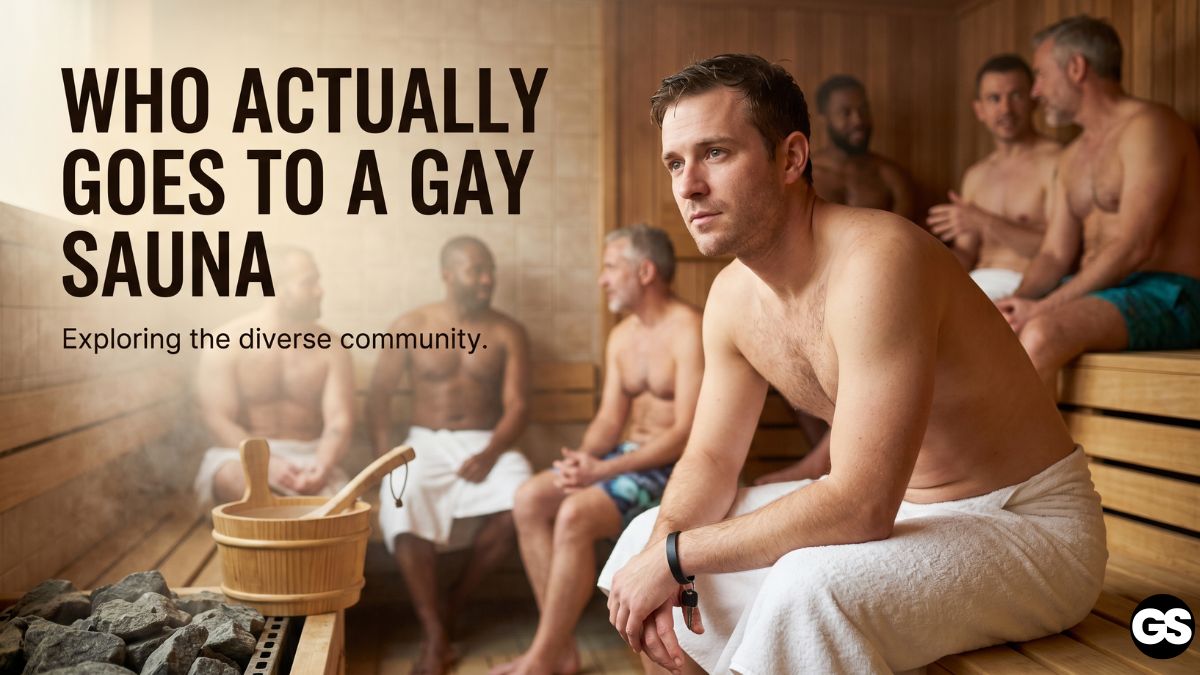
A bit of everyone. That's the short answer to the question most first-timers want answered before they get within a mile of the door.
The longer answer is that the assumption a gay sauna is full of one specific kind of man — out, gym-built, in his thirties, very experienced — is the assumption that gets the place wrong. Walk into any UK venue on a busy night and you'll see roughly the same cross-section of men you'd see on a delayed train.
If you're worried you won't fit the type, the trick is realising there isn't really a type to not-fit.
The age range is wider than you think
Most UK saunas pull a crowd from the early twenties through to the late sixties. That's not a stretch — it's a normal Tuesday.
Younger guys tend to skew toward the weekends, particularly the evenings. Older regulars tend to anchor the weekdays and the daytime sessions, partly because they've been doing this for years and know which slots are quietest.
You will not be the youngest there. You will not be the oldest. If you're in your forties or fifties and convinced you're "past it" for this kind of place, walk in on a Wednesday afternoon and you'll be standing in the middle of your own demographic.
The body range is wider than you think too
The mythology that everyone in a gay sauna has the same V-shaped torso is wrong, and it's the bit that puts the most men off needlessly. The men in there look like the men outside.
Soft, lean, broad, slim, hairy, smooth, paunchy, lanky. Gym-built guys exist; so do guys who haven't been to a gym since school. A regular weeknight crowd is closer to a corner-shop queue than a fitness magazine.
Towels do most of the equalising work. Once everyone's in a towel, the stuff people fixate on in clothes — height, build, what shape you are — flattens out fast.
Out, married, bi, curious — they're all in there
Sauna crowds run wider than the "out gay men" assumption, and most regulars know that. Plenty of married men go. Plenty of bi men go. Plenty of men who don't use any label at all go.
Some are completely out and would happily tell their boss where they were last weekend. Some keep this part of their life entirely separate from the rest of it, by choice. The place doesn't ask, and other men in the building have neither the inclination nor the standing to ask either.
What you call yourself outside the door is your business. Inside the door, the only thing that matters is that you're there.
The crowd shifts depending when you go
Time of day reshapes the room more than identity does. A 2 p.m. Tuesday and an 11 p.m. Saturday at the same venue are essentially two different experiences with the same furniture.
Daytime weekdays skew older and quieter — guys with flexible jobs, retired regulars, men using their lunch break, shift workers. The energy is calmer, the lounge has people reading, the cabin floor is steady rather than busy.
Friday and Saturday nights pull a younger, busier, louder crowd. Themed nights — naked nights, particular age brackets, fetish-specific evenings — pull a more focused crowd than a standard session does. If you're trying to find the room you'll be most comfortable in, the time slot matters more than anything else.
Why the assumption gets the place wrong
The "everyone in there is out, gym-built, and in their thirties" picture is mostly imported. It's the version of the venue that lives in films, on hookup-app conversation threads, and in the heads of men who haven't actually been.
The actual building doesn't filter for any of that. The fee at reception buys you a towel and a locker, and the door doesn't know whether you're out, what you do for a living, or what your body looks like under the clothes you arrived in.
Every regular started off exactly the way you're about to — convinced they didn't fit and quietly worried they'd be the odd one out. They were not. Neither are you.
What the room actually feels like
The lounge of a typical UK sauna feels closer to a midweek pub than anything else. Men sit, men chat, men read, men watch the TV in the corner with the sound off. There's no charged stare-down at the door, no walk of judgement when you arrive.
You'll see a couple chatting on a bench, a single guy in his sixties with a coffee, a younger pair laughing about something that happened in the steam room, a quiet middle-aged guy with a book.
It's a sit-down room with men in towels in it. The mythology around what kind of man is "supposed" to be there falls apart within five minutes of being in the actual building.
What this means for your first walk-in
If you're nervous about whether you'll fit, the first-visit page covers the practical "what happens" beat by beat, and the dos and don'ts page covers the unspoken rules of moving around inside. Both are worth a read before you go.
If you're nervous about whether the place is for you at all, the foundational explainer is the calmer entry point.
You're not the wrong age. You're not the wrong shape. You're not too out, too closeted, too curious, too married, or too anything else for the door. You're just a bloke who's thinking about going.
The short version
Whoever showed up showed up. The assumption that there's a uniform crowd is the wrong starting point — the place welcomes the man at the door without asking him to be a particular kind of man first.
Walk in once and you'll see the room is wider than you thought. After that, it's just where you go.